
Why HVAC Companies Need Dedicated VRF installation management software (Not Excel)
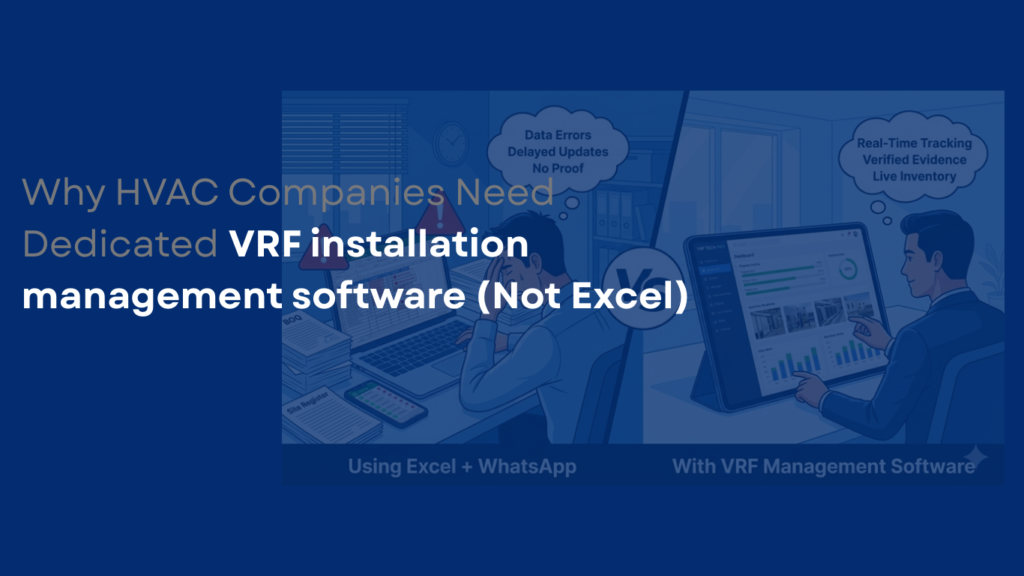
At the planning stage, most VRF projects look completely under control. The BOQ is ready, the timeline is agreed upon, and the team has done similar installations before. On paper, everything makes sense. But once work starts on site, that neat plan begins to stretch. Different crews move at different speeds, material deliveries don’t always match the schedule, design changes come in mid-way, and commissioning suddenly needs proper documentation for every stage.
Despite this, many HVAC companies are still trying to run these projects through Excel files, WhatsApp messages, and site registers. It feels workable in the beginning because everyone is “managing somehow.” The problems show up later, when material is missing but the sheet says it’s available, when a milestone is marked complete but there’s no proof, or when a delay happens and nobody can clearly trace where things actually slowed down.
For businesses handling multiple VRF sites, this approach starts affecting margins, timelines, and client confidence. That’s why moving to VRF installation management software isn’t really a tech upgrade anymore; it’s an operational necessity if you want consistent speed and visibility across projects.
And this is the real shift happening in the industry. The discussion is no longer about going digital at some point in the future. It’s about Excel vs HVAC software, the difference between piecing together updates at the end of the day and knowing, in real time, what’s actually happening on your sites.
The traditional toolkit: Excel + WhatsApp + manual registers
Let’s be honest, this is the setup most HVAC teams start with. Not because it’s perfect, but because it’s there. Excel is easy, WhatsApp is already on everyone’s phone, and the site register has been around forever, so nobody questions it.
- Excel for the BOQ, for progress tracking, for planning what to order next
• WhatsApp for updates, site photos, and “Done” messages at the end of the day
• Manual registers for stock in, stock out, and signatures when someone asks for records
For a small job, this doesn’t look like a problem. You can still call the supervisor and get clarity. You can open the sheet and more or less understand the status.
The confusion starts when the project grows.
Now there are multiple floors. Different teams. Material is coming in at different times. Two people updating the same file. One person is checking numbers that were correct yesterday but not today. The sheet says something is available, the site says it’s finished, and the purchase team is stuck in between trying to decide who is right.
The real problem is not Excel or WhatsApp. The real problem is that we’re trying to run execution using tools that were only meant to store information. They don’t show the current situation on site. So the team spends half the day following up, cross-checking, and asking for confirmations.
And as the project gets bigger, this follow-up work increases. More manual entries. More chances to miss something. More time spent figuring out which update is the latest. Work is happening on site, but visibility is always one step behind.
The hidden costs of “Excel works for us”
Excel fails quietly at first. The expenses become visible retrospectively- when you find yourself behind schedule.
1) Data errors and fragile processes
Spreadsheets are dependent on human beings to be filled in, copied, pasted, sorted, filtered and updated. That forms a huge error surface zone- particularly when several individuals are modifying or emailing final-v7s. Studies on operational spreadsheets have long pointed to the ease of making errors during incorrect data entry, overwriting formulas, or, worst of all, sorting the sheet inappropriately, despite the correctness in the sheet structure.
2) No real-time visibility
Your project manager poses, What is the actual progress on Floor 9, and the response will be based on who last updated the sheet. Spreadsheets do not have the innate ability to produce field activity to a live dashboard. Contemporary methods focus on real-time, data-based monitoring since it enhances the efficiency of early delay detection and decision-making.
3) Lack of accountability and proof
Excel is capable of saying Pressure Test, Done. But where is the proof? Which technician did it? At what time? Was it approved? What photos were captured? Excel is unable to generate an audit trail when a client raises a quality.
4) Multi-site coordination becomes chaos
As soon as you add several buildings, towers or campuses, spreadsheets become isolated silos. You lose one of the sources of truth. This is when delays and procurement errors go up.
WhatsApp is communication—not execution control
WhatsApp is fast. That’s exactly why everyone depends on it. But try using it to track actual work on a VRF site and you’ll see the problem. An update comes in the morning, by afternoon it’s buried under “OK”, “Noted”, and a few unrelated photos. Someone says a task is complete, someone reacts with, and that becomes the approval. A week later, when you really need to check what happened, nobody is sure who confirmed it or when.
For normal conversation, this is fine. For installation and commissioning, it creates confusion.
Because VRF work doesn’t move on verbal confirmation. Each stage—piping, insulation, wiring, testing—has to be properly checked and signed off. When commissioning starts, you can’t open a chat and start searching for proof. You need a clear record. What was done, who verified it, and whether it was actually cleared to move to the next stage.
Chat only tells you that people spoke. It doesn’t tell you the status of the work.
And that’s where teams start struggling. The information exists somewhere in the group, but it’s not in a form you can rely on. So you call people again, ask for photos again, and confirm the same thing again. Time goes there instead of execution.
Why VRF installations need purpose-built workflows (not generic tracking)
VRF is not an HVAC install. It is a heavy-workflow of coordination that even minor faults in execution may lead to significant delays in the future:
- floor/zone circuit-level installation.
- pressure testing and documentation.
- regulated material consumption (copper, insulation, fittings, valves, wiring, controllers)
- commissioning and handover documentation preparation.
General construction PM tools are assistive, but fail to meet the VRF execution reality: circuit hierarchies, milestone verification, and site inventory directly related to work completion.
This is why specific tools are being developed: they concentrate on live site operation, organised milestones, and evidence-based progress, so management is not operating off of updates posted at the end of the day.
Excel vs HVAC software: what changes when you modernize
From manual updates → structured milestone completion
The system does not require technicians to be asked to update the sheet but to accomplish milestones (such as piping, wiring, pressure testing, drainage, commissioning) with needed evidence.
From scattered photos → verified evidence
Photos and notes are taken and attached to the specific milestone/circuit, enabling evidence to be searched and audited – helpful in quality control and conflict avoidance.
From delayed reporting → instant dashboards
Field updates are updated instantly to ensure that supervisors and managers are aware of bottlenecks early rather than at the end of the week at the weekly meeting. On-time tracking is recurrently linked with improved decision-making and productivity on ventures.
From “inventory guessing” → live stock visibility
One of the largest unspoken hemorrhages on HVAC sites is inventory. Digital workflows help you to trace receipts, usage, and stock more trustworthy than the registers and spreadsheets, minimizing loss, theft, and emergency purchases.
What “dedicated VRF management” looks like in practice
An actual HVAC installation management platform cannot be just a digital checklist. It must tie four things together in a circle:
- Plan (location site circuits)
- Milestones (predefined levels with confirmation)
- Inventory (what was received, what was used, what was available)
- Problems (reported on the job, followed up to resolution with accountability)
It is that structure that transforms site data into management control.
That is where VRF TECH PRO would be placed: a dedicated system designed to execute VRF, which structures projects into circuit hierarchies, monitors milestones with validation (photo/voice/time), links material consumption to progress, and implements control and traceability approval workflows.
That is, it is not software that stores updates. It is the mechanism that motivates right performance.
How VRF TECH PRO closes the gaps Excel can’t
According to the design of the platform, VRF TECH PRO will target the specific pain points that HVAC teams experience during installation:
Role-based workflows (so everyone uses it)
- Simple mobile flow: update milestones: technicians have the opportunity to add voice notes, upload photos, and record material usage, and raise issues.
- Supervisors grant milestones and inventory use, fix problems and organise teams.
- Project managers receive a web dashboard of control, analysis, approvals and reporting.
The way you guard against tools nobody updates is role-based execution.
Milestone verification creates an audit trail
Every milestone reached is a record: by whom, when, and what evidence. This assists quality control as well as minimizes rework.
Site inventory control linked to actual work
GRN uploads, justification of use, supervisor approvals and automatic deductions result in traceability, so inventory does not disappear between received and used.
Issues don’t get lost
Rather than recording that someone said there is a shortage, problems are entered with category, severity, and evidence- and followed to closure.
In simple terms, in case you need a concise explanation: VRF TECH PRO is a VRF project tracking tool that integrates execution evidence, inventory management, and approvals under a single system- so projects do not get lost.
The biggest business impact: speed, predictability, and margin
When organizations abandon spreadsheets and chat-based coordination in favor of structured and real-time systems, the wins are usually apparent in five areas:
- Quicker response (less waiting, reduced follow-ups, clearer next steps)
- Less rework (proof and verification at each stage)
- Reduced material leakage (tracked inventory and approvals)
- Improved decisions (real-time dashboards, as opposed to delayed reporting)
- Cleaner handover (recorded milestones and handover readiness)
This is why structured tracking is viewed by many firms as a competitive advantage, as it compounds across all projects, crews and sites.
That is the actual change: you no longer deal with updates, you deal with execution.
What to look for when choosing the right tool
Not all apps that track projects will be compatible with VRF. Evaluate with this shortlist:
- Does it accommodate circuit/floor/project hierarchies?
- Can technicians update on mobile in seconds?
- Does it need evidence (pictures/notes) to major steps?
- Are milestones and inventory usage approvable by supervisors?
- Inventory (not separate registers)?
- Do PMs have live dashboards in different locations?
- Does it record problems with report-resolution?
- Does it generate exportable client and management reports?
When you need to install the Best VRF installation management software, it is worth considering the tools that are designed to execute VRF, rather than a generic task tracker renamed and repackaged.
With proper procedure, you shift among daily firefighting to managed delivery, particularly when you standardise work by team and project using Digital HVAC management.
Lastly, to leadership teams: the most telling sign of an upgrade that has been successful is nothing more complicated than your project reviews ceasing to be arguments about whose sheet is right and instead becoming a decision made based on a single live source of truth with HVAC project tracking software.
FAQs
1) Why isn’t Excel enough for VRF project execution?
Excel is wonderful in that it is used in static planning, whereas VRF implementation requires real-time progress, evidence of completion, approvals, and traceability, particularly across floors and various sites. Spreadsheets are delicate in terms of manual input and versioning, and errors can be introduced by any person.
2) What’s the biggest risk of using WhatsApp for site reporting?
WhatsApp is not created to ensure organized execution: updates are lost, accountability is ambiguous, and audit trails are weak, which is dangerous when needed to deliver quality, compliance, and dispute resolution.
3) How does dedicated software improve installation speed?
Through standardisation workflows, real-time capturing of milestone progress in the field and real-time provision of dashboards to managers to help in identifying delays at the earliest, enhancing decision-making, and efficiency.
4) Can VRF TECH PRO help reduce material loss?
Yes, its workflow is structured with real-time inventory visibility, regulated material usage entries, approvals, and total traceability of transactions that prevent leakage and unauthorised usage.
5) What’s the first step to switch from Excel to software?
Begin with a single live project: post BOQ/circuits, establish milestone steps, and perform technician updates and supervisor approvals within the system. After the reporting and inventory become reliable, scale it across the sites.